
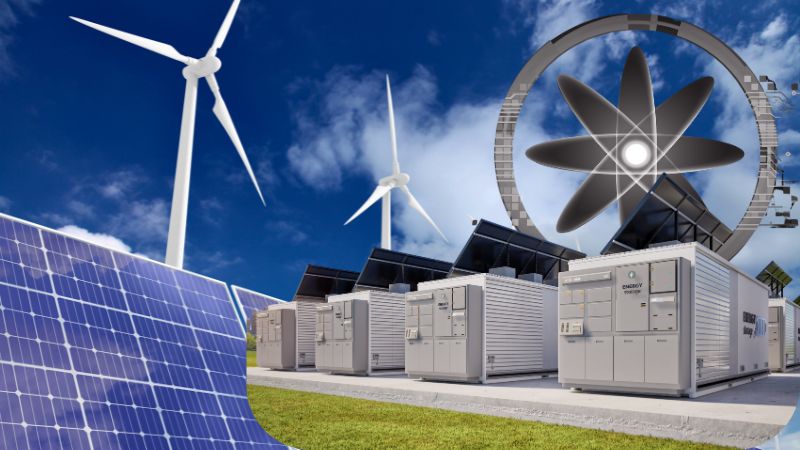
Toyota, Mitsubishi Electric, and Infineon have launched projects, while two government agencies—the State of California and the U.S. Department of Energy—plan new initiatives.
Multiple factors affect energy progress. Companies design and manufacture new technologies, form partnerships, and plan projects. All this happens amidst various government policies and legislation.
In the latest, Toyota is partnering with a mining company to secure cathode materials for its solid-state batteries. Mitsubishi is partnering with ITRI on power conversion systems, and Infineon is purchasing energy from three European wind farms. In government moves, California has initiated a law that affects battery energy storage systems, and the U.S. Department of Energy plans to accelerate fusion technology.
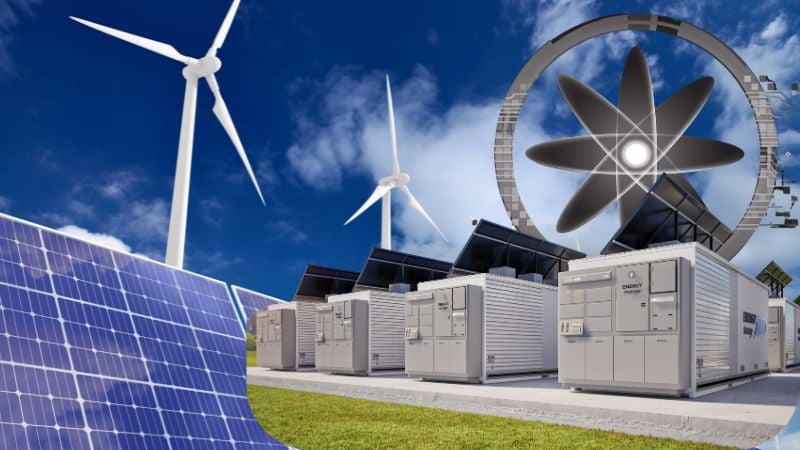
Wind, solar, battery storage, and fusion. Adapted from images used courtesy of Canva
Toyota Secures Cathode Materials for Solid-State Batteries
Toyota has made a deal with Sumitomo Metal Mining Company in Japan to mass-produce cathode materials for its solid-state batteries. Toyota plans to use the batteries in its 2027 and 2028 battery-electric vehicles. The automaker stated its solid-state batteries will offer shorter charging times, longer range, and better performance.
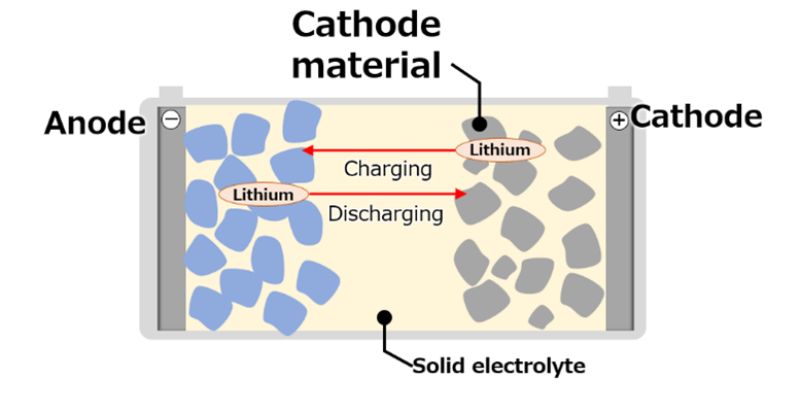
Solid-state battery structure. Image used courtesy of Toyota
Toyota and Sumitomo Metal Mining have been working together since 2021 to develop cathode materials that resist degradation after repeated charging cycles. The result was Sumitomo’s proprietary powder synthesis cathode technology, which it claims is “highly durable.”
Mitsubishi Electric and ITRI Partner for Large-Capacity Power Conversion System
Mitsubishi Electric and Taiwan-based Industrial Technology Research Institute (ITRI) will collaborate to develop high-voltage, high-current power conversion systems (PCSs) using high-efficiency power semiconductors for renewable energy generation. Mitsubishi Electric stated the megawatt-class PCS can efficiently convert the large amounts of energy that large-scale renewable energy systems produce.
ITRI will contribute design documents and test results related to PCSs using Mitsubishi Electric’s power semiconductor modules. Mitsubishi will market the information to Taiwanese PCS manufacturers to support the renewable energy transition.
Infineon Purchases Wind and Solar Power in Europe
Infineon has contracted with renewable energy companies PNE AG and Statkraft to purchase electricity generated by wind and solar power over the next 10 years.
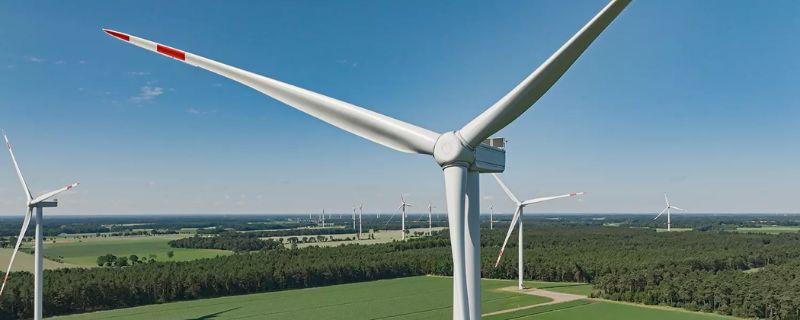
The Kittlitz wind farm in Brandenburg. Image used courtesy of PNE AG
PNE AG’s Schlenzer and Kittlitz II wind farms in Brandenburg will supply power to four Infineon sites. The wind farms will produce 24 MW of capacity and 550 GWh of contracted electricity volume. Statkraft’s solar farms in Spain will deliver 220 GWh to German sites over the next five years.
The move is part of Infineon’s goal to transition to 100% clean energy by the end of this year. It aims to become CO2-neutral by 2040.
California Takes Aim at BESS Fires
California has enacted stronger battery safety regulations in response to the massive Moss Landing battery energy storage system (BESS) fire in January. That fire burned for more than five days, destroying 75% of the 300 MW facility and costing about $400 million. About 1200 people were evacuated.
California SB 283 requires battery storage developers to consult with fire authorities about system design, risks, and emergency responses before submitting an application. Inspections will be required before a BESS can begin operations. The National Fire Protection Association’s new 855 standards, which will go into effect in January 2026, will apply. The BESS developer will pay the costs.

The Moss Landing BESS fire. Image used courtesy of Wikimedia Commons
The Moss Landing fire’s exact cause is still undetermined. The facility used lithium nickel manganese cobalt oxide batteries. Monterey County continues to monitor possible impacts on air, soil, and water.
DOE Creates Roadmap to Speed Up Fusion Commercialization
The U.S. Department of Energy has released a roadmap to make nuclear fusion power a reality by the mid-2030s. The Fusion Science and Technology (FS&T) Roadmap establishes three primary goals:
- Building critical fusion infrastructure
- Encouraging research, high-performance computing, and AI
- Forming public-private partnerships, regional workforce hubs, and workforce development
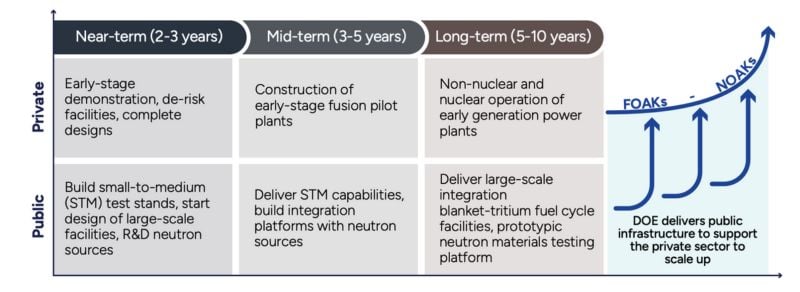
The DOE’s timeline. Image used courtesy of DOE
The DOE stated it wants to “close the remaining technical gaps” in private reactor technology, including materials, fuel cycles, plasma systems, and plant engineering. The DOE plans investments in structural materials, confinement systems, plasma-facing components, blankets, plant engineering, and fuel cycles.
